
| Pakistan |
|
|
 |
|
| Geography | |
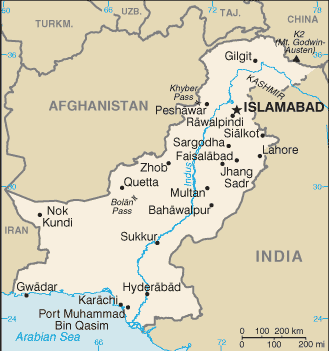
| Location: | Southern Asia, bordering the Arabian Sea, between India on the east and Iran and Afghanistan on the west and China in the north. |
| Area: | total:
796,095 sq km land: 770,875 sq km water: 25,220 sq km |
| Natural Resources: | land, extensive natural gas reserves, limited petroleum, poor quality coal, iron ore, copper, salt, limestone |
| Population and Health | |
| Population: | 196,174,380 (July 2014 est.) |
| Age structure: | 0-14 years: 33.3% (male 33,595,949/female 31,797,766) |
| Population growth rate: | 1.49% (2014 est.) |
| Birth rate: | 23.19 births/1,000 population (2014 est.) |
| Death rate: | 6.58 deaths/1,000 population (2014 est.) |
| Sex ratio: | at birth: 1.05 male(s)/female |
| Infant mortality rate: | total: 57.48 deaths/1,000 live births |
| Life expectancy at birth: | total population: 67.05 years |
| Total fertility rate: | 2.86 children born/woman (2014 est.) |
| Current contraceptive use among married women 15-49 years old(any method): | 27% (2007-2012) |
| Unmet need of contraceptive: | 25.2% (2007) |
| HIV/AIDS - people living with HIV/AIDS: | 86,700 (2012) |
| HIV/AIDS - deaths: | 3,500 (2012) |
| Literacy: | definition: age 15 and over can read and write |
| Economy | |
| GDP (purchasing power parity): | $574.1 billion (2013 est.) |
| GDP (official exchange rate): | $236.5 billion (2013 est.) |
| GDP - real growth rate: | 3.6% (2013 est.) |
| GDP - per capita (PPP): | $3,100 (2013 est.) |
| GDP - composition by sector: | agriculture: 25.3% |
| Labor force - by occupation: | agriculture: 45.1% |
| Population below poverty line: | 22.3% (FY05/06 est.) |
| Inflation rate (consumer prices): | 7.7% (2013 est.) |
| Agriculture - products: | cotton, wheat, rice, sugarcane, fruits, vegetables; milk, beef, mutton, eggs |
| Industries: | textiles and apparel, food processing, pharmaceuticals, construction materials, paper products, fertilizer, shrimp |
| Industrial production growth rate: | 3.5% (2013 est.) |
| Exports - commodities: | textiles (garments, bed linen, cotton cloth, yarn), rice, leather goods, sports goods, chemicals, manufactures, carpets and rugs |
| Currency (code): | Pakistani rupee (PKR) |
| Others | |
| Nationality: | noun:
Pakistani(s) adjective: Pakistani |
| Religions: |
Muslim 95% (Sunni 75%, Shia 20%), other (includes Christian and Hindu) 5% |
| Languages: |
Punjabi 48%, Sindhi 12%, Siraiki (a Punjabi variant) 10%, Pashtu 8%, Urdu (official) 8%, Balochi 3%, Hindko 2%, Brahui 1%, English (official; lingua franca of Pakistani elite and most government ministries), Burushaski and other 8% |
| Country name: | conventional
long form: Islamic Republic of Pakistan conventional short form: Bangladesh former: West Pakistan |
| Government type: | federal republic |
| Capital: | name:
Islamabad geographic coordinates: 33 42 N, 73 10 E time difference: UTC+5 (10 hours ahead of Washington, DC during Standard Time) |
| Administrative divisions: | 4
provinces, 1 territory*, and 1 capital territory**; Balochistan, Federally
Administered Tribal Areas*, Islamabad Capital Territory**, Khyber Pakhtunkhwa
(formerly North-West Frontier Province), Punjab, Sindh note: the Pakistani-administered portion of the disputed Jammu and Kashmir region consists of two administrative entities: Azad Kashmir and Gilgit-Baltistan |
| Independence: | 14 August 1947 (from UK) |
| Legal system: | based on English common law with provisions to accommodate Pakistan's status as an Islamic state; accepts compulsory ICJ jurisdiction, with reservations |
|
|
|
| Source : UN_Demographic and Health Surveys (DHS), Multiple Indicator Cluster Surveys (MICS) and other national surveys; United Nations Population Division Update date: August 2014
|
|