
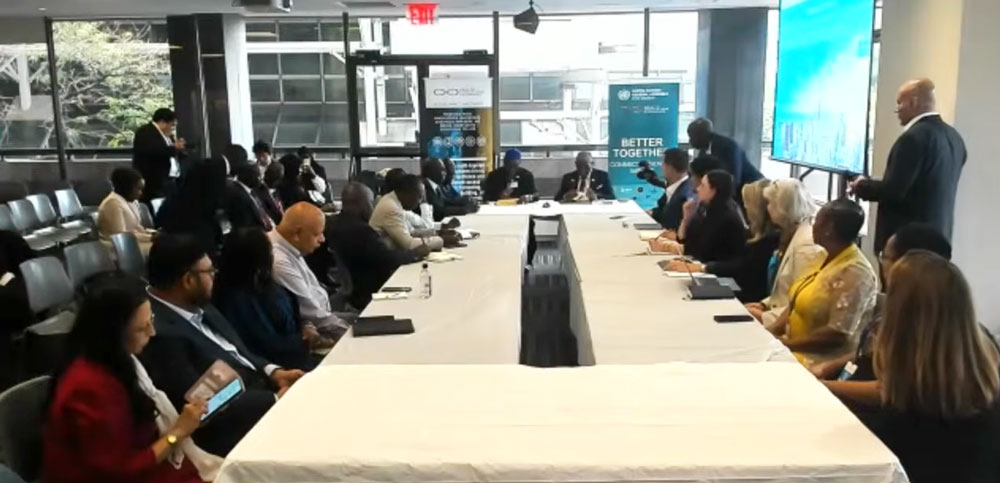
NEW YORK, 24 September 2026 — Partners in Population and Development (PPD) convened a High-Level Ministerial Dialogue on the sidelines of the 81st Session of the UN General Assembly in New York, bringing together government ministers, senior UN officials, and leading health innovation experts from across the Global South to confront one of the most consequential financing challenges of our time: how to build a sustainable, equitable, and effective architecture for financing sexual and reproductive health in developing countries.
Held under the theme “Financing the Future: Domestic Resources, Catalytic Capital and South-South Cooperation for Sexual and Reproductive Health”, the 75-minute event drew a high-level audience of government delegates, representatives of UN agencies, development finance institutions, civil society organisations, and members of the international development community attending the General Assembly session in New York.
The Ministerial Dialogue was structured around PPD’s compelling three-pillar financing framework of FUND, LEVERAGE, and INVEST, a framework designed to move the global conversation on sexual and reproductive health financing beyond fragmented project-based funding toward a coherent, country-owned financing architecture that distinguishes core public obligations from investable opportunities, and deploys domestic, concessional, catalytic, and private capital according to their respective comparative advantages.
The Dialogue explored four complementary financing pathways: strengthening domestic public finance as the foundation for essential sexual and reproductive health services; deepening risk pooling and strategic purchasing through universal health coverage mechanisms; deploying catalytic and concessional finance to unlock investments at scale; and mobilising private and institutional capital in commercially viable segments of the sexual and reproductive health space. A dedicated segment examined how South-South and Triangular Cooperation can be elevated from knowledge exchange to capital mobilisation, creating a new and transformative financing architecture for sexual and reproductive health across the Global South.
The Dialogue featured substantive contributions from an exceptional panel of speakers whose collective experience spanned government, intergovernmental institutions, and health innovation.
H.E. Dr. Muhammad B.S. Jallow, Vice President of the Republic of The Gambia and Member of the PPD Board and Executive Committee, brought the weight of the highest political authority to the platform. Speaking to the realities of fiscal constraint in small developing states, H.E. Dr. Jallow made a powerful case for nationally owned and sustainable solutions to sexual and reproductive health financing, arguing that protecting essential services in an era of constrained fiscal space requires not only political will but a fundamental rethinking of how governments prioritise, plan, and invest in their people.
Ms. Angelina Kodua Nyanor, Acting Executive Director of the National Population Council of the Republic of Ghana and PPD Board Member, delivered a grounded and authoritative perspective on domestic resource mobilisation, strategic purchasing, and the integration of sexual and reproductive health into universal health coverage financing frameworks. Drawing on Ghana’s experience, she made a compelling case for embedding sexual and reproductive health firmly within medium-term fiscal planning as a non-negotiable public investment rather than a discretionary line item vulnerable to budget cycles and shifting donor priorities.
Professor Dr. Joseph Akinkugbe Adelegan, Executive Director and Chief Executive Officer of PPD, set out PPD’s vision for a new generation of South-South Cooperation that goes beyond knowledge exchange to become a genuine capital mobilisation architecture. He introduced PPD’s proposed Catalytic Financing Platform for Sexual and Reproductive Health, a transaction-origination and project-preparation mechanism designed to connect country demand with multilateral development banks, development finance institutions, bilateral partners, United Nations agencies, and philanthropy. The platform, he argued, would help transform proven South-South solutions into finance-ready investment cases capable of attracting the scale of public, concessional, and appropriately structured private capital that the challenge demands.
Mr. Pradeep Kakkattil, Chief Executive Officer and Founder of the Health Innovation Exchange (HIEx) in Geneva, brought the perspective of health innovation and catalytic investment to the Dialogue. Drawing on HIEx’s track record of facilitating over USD 200 million in health investments and its pioneering work in connecting political leadership with innovators and investors across the Global South, Mr. Kakkattil made the case for moving from innovation to investability arguing that digital health solutions, local manufacturing, and technology-enabled sexual and reproductive health services represent a substantial and largely untapped opportunity for catalytic and private capital if the right enabling conditions, de-risking instruments, and investment pipelines are put in place.
Closing the event, Professor Adelegan described the Dialogue as a turning point in how PPD approaches its mandate. For too long, the financing of sexual and reproductive health has been treated as a matter of aid dependency and donor goodwill. What we agreed today is something different. It is a commitment to build a financing architecture that is nationally owned, regionally grounded, and globally connected, one that uses South-South Cooperation not just to share what works, but to finance it at scale. PPD is ready to make that happen, and today’s Dialogue has given us a clear mandate to move forward.
