
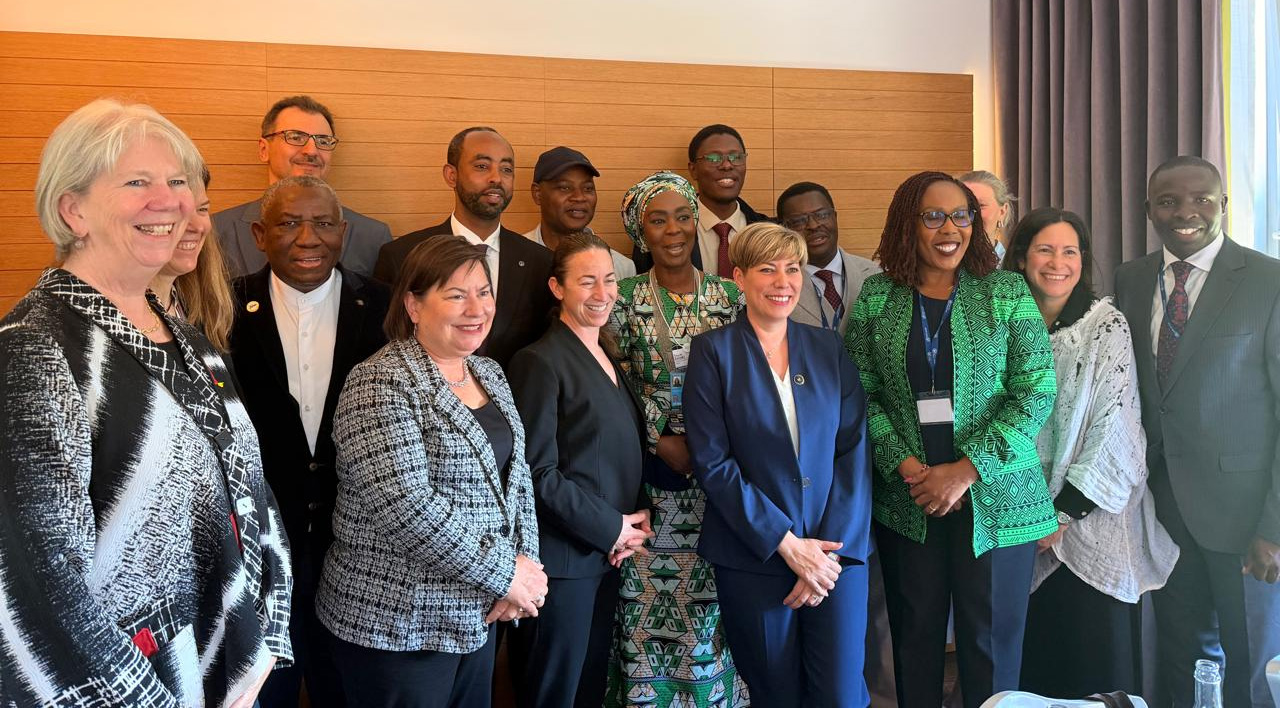
20 May 2026, Geneva, Switzerland – The Executive Director of Partners in Population and Development (PPD), Professor Dr. Joseph Akinkugbe Adelegan, attended and delivered a presentation at the high-level side event, “Digitising the Maternal Health Workforce: From a National Partnership to a Continental Ecosystem,” held on 20 May 2026 in Geneva, Switzerland, on the margins of the 79th World Health Assembly (WHA79). The event was organized by the Wellbeing Foundation Africa and Proximie, in partnership with The Health Innovation Exchange (HIEx).
The high-level side event, titled “Digitising the Maternal Health Workforce: From a National Partnership to a Continental Ecosystem,” was not a routine conference panel, it was a focused, action-oriented dialogue designed to move beyond fragmented and short-term interventions, and to explore realistic, coordinated pathways toward a digitised, government-anchored ecosystem for the maternal health workforce at continental scale. The meeting also marked a significant institutional moment, with the formal signing of a Memorandum of Understanding between the Wellbeing Foundation Africa and Proximie, witnessed by participating ministers and senior delegates.
Professor Adelegan opened his remarks with a sobering reminder of what is at stake. Africa continues to bear a disproportionate share of global maternal deaths, with the heaviest burden falling on rural and underserved communities that are often the furthest from care. Behind these statistics, he noted, lie systemic failures that have persisted for too long, workforce shortages, uneven distribution of skilled personnel, weak referral systems, inadequate remuneration, fragmented information systems, and critical infrastructure gaps. These are not new problems, but they demand a new kind of response.
That response, he argued, must be rooted in digitisation not as a buzzword, but as a genuine strategic tool for transforming how the maternal health workforce is trained, deployed, supported, and retained. Drawing on concrete examples, Professor Adelegan outlined a range of digital interventions capable of making a tangible difference: mobile health platforms that extend the reach of frontline workers, digital workforce training that delivers updated clinical guidance at scale, telemedicine and remote consultation services that connect rural facilities to specialist care, artificial intelligence tools for predictive risk assessment and decision support, and digital payment systems that can improve both workforce retention and accountability. Together, he emphasized, these tools can strengthen communication, support earlier identification of high-risk pregnancies, and enable more effective, data-driven governance of health systems.
Yet Professor Adelegan was equally candid about the risks of the status quo. Too many promising national digital health projects remain trapped in their own silos unable to scale because of weak interoperability, limited sustainable financing, and insufficient regional coordination. The solution, he argued, is not more isolated projects, but a genuinely continental ecosystem: one that supports interoperable digital health records, cross-border workforce credentialing, shared digital health standards, regional training platforms, and coordinated maternal health data systems that can inform policy and investment across borders.
He also raised a challenge that is easy to overlook in high-level discussions: the risk that digital transformation widens, rather than narrows, existing inequalities. For digitisation to truly reach the mothers who need it most, he stressed that affordable devices, digital literacy training, language-inclusive interfaces, continuous technical support, and deliberate investment in rural digital infrastructure including reliable electricity and broadband connectivity are not optional add-ons but essential foundations. He further underlined the importance of data governance, privacy protections, and cybersecurity as pillars of trust that must be built into any sustainable digital health system from the outset.
Underpinning all of this, Professor Adelegan called for strong public-private partnerships and close alignment with Universal Health Coverage (UHC) and Sustainable Development Goal (SDG) commitments ensuring that digital innovation is not pursued in isolation, but as part of a broader architecture of accountability and long-term financing.

In closing, he reaffirmed that digitising the maternal health workforce represents one of the most promising and most urgent pathways to improving maternal healthcare delivery across Africa. Success, he concluded, will not come from fragmented initiatives, but from integrated, partnership-driven ecosystems that bring together governments, international organizations, technology providers, and communities in genuine collaboration. PPD’s participation in the dialogue reflected its enduring commitment to advancing South-South and Triangular Cooperation, strengthening health systems, and supporting practical, scalable innovation in service of better maternal and newborn health outcomes.
